
Marine collagen has moved from niche beauty product to mainstream wellness staple in Australia over the past five years. The category is now crowded with options — different fish species, different processing methods, and a wide range of price points. The honest answer to which marine collagen is worth taking comes down to source, peptide profile, and what you are actually trying to achieve.
Cod-derived marine collagen sits in an interesting place. It uses an otherwise low-value byproduct of cold-water food fishing, delivers a clean Type I peptide profile, and is generally well tolerated. It is also one of the cleaner-tasting marine collagens, which matters more than people expect when they are using it daily.
What Marine Collagen Actually Is
Collagen is the most abundant protein in the human body. It is the structural scaffolding of skin, tendons, ligaments, cartilage, bone matrix, and the lining of blood vessels. There are 28 known types of collagen, but Types I, II and III account for the vast majority of what the body uses every day.
Type I collagen makes up around 90 percent of skin collagen and is the dominant type in tendons, bones, and connective tissue. Type II is the primary collagen in cartilage. Type III sits alongside Type I in skin and is more common in young skin, declining with age.
Marine collagen, the kind sourced from fish, is overwhelmingly Type I. That makes it well-matched to skin, hair, nails, and connective tissue applications. Bovine collagen also delivers Type I but pairs it with Type III. Chicken-derived collagen is the major source of Type II for joint-cartilage formulations.
The "peptides" descriptor on the label means the collagen has been hydrolysed — broken down into smaller chains of amino acids that are more easily absorbed than whole collagen protein. Hydrolysis is what allows the powder to dissolve completely in water and avoids the gelling behaviour of unhydrolysed gelatin.
Why Fish Species Matters
Not all marine collagen is the same, even before you consider the manufacturing process.
Cod and other cold-water white fish tend to produce cleaner-tasting, lower-odour peptides. The collagen comes primarily from the skin, which is otherwise a low-value byproduct of food fish processing. Cod is wild-caught from well-managed North Atlantic and North Pacific fisheries, which adds a sustainability angle that farmed sources do not always carry.
Tilapia is the most common warm-water source of marine collagen. It is widely available and inexpensive, but tilapia farming has variable environmental and food safety standards depending on country of origin. The peptides themselves can carry a slightly stronger fishy aftertaste than cold-water sources.
Shellfish-derived collagens exist but carry a higher allergy risk and are not appropriate for people with shellfish allergies.
For Australian buyers, the practical questions are: where is the fish from, how was it caught or farmed, and what testing has been done for heavy metals and contaminants? A reputable manufacturer will be able to answer all three.
Marine vs Bovine Collagen
Both work. The choice is mostly about preference and dietary context.
Marine collagen has smaller average peptide sizes, which is sometimes marketed as faster absorption. The clinical evidence for a meaningful absorption difference between marine and bovine peptides is weaker than the marketing implies — both are absorbed well at typical doses.
Marine collagen suits people who avoid bovine products for cultural, religious, or dietary reasons. It also suits people who simply prefer a marine source. It is not suitable for vegans or vegetarians, despite what some confused marketing might suggest — collagen is by definition an animal-derived protein.
Bovine collagen offers a Type I and Type III blend, which some people prefer for skin applications. It typically costs less per gram. For a gut-health focus, hydrolysed bovine collagen and bovine gelatin both deliver glycine and proline in slightly different formats.
For an in-depth look at the research base for marine collagen, see our piece on what the marine collagen research actually shows.
What the Research Says on Skin and Joints
There is now a reasonable body of clinical research on hydrolysed collagen peptides. The strongest signals are in two areas.
For skin, several randomised trials have shown improvements in skin elasticity, hydration, and dermal collagen density after 8 to 12 weeks of daily collagen peptide use at doses of around 5 to 10 grams. Effect sizes are modest but consistent, and the trials have generally been well controlled.
For joints, smaller studies have shown reductions in joint discomfort in active adults and people with mild osteoarthritis after 12 to 24 weeks of daily use. The mechanism is plausible — collagen peptides appear to influence collagen turnover in cartilage — but the evidence base is thinner than the skin literature.
For nails, small trials have shown reduced brittleness and faster growth. For hair, the evidence is less clear and most claims are based on subjective user reports rather than measured outcomes.
How to Use Marine Collagen Daily
The key word is daily. Collagen peptides are a slow, cumulative supplement. A bottle used inconsistently produces little. A daily scoop used for 12 weeks gives you a fair test of whether the product is helping.
A standard serve is around 10 grams — typically one scoop of powder. The unflavoured powder mixes into coffee, smoothies, juice, or plain water without changing taste or texture. Hot drinks dissolve the powder slightly faster but cold liquids work fine with brief stirring.
Vitamin C supports collagen synthesis in the body, so taking marine collagen alongside a vitamin-C-rich food or drink — citrus juice, kiwifruit, capsicum — is a small optimisation worth making.
Who Should Be Cautious
People with a fish allergy must avoid marine collagen. Read the allergen statement carefully — most marine collagens are derived from fish skin and carry the same allergen risk as eating fish.
People who follow a strict vegan or vegetarian diet should not use any collagen product, marine or otherwise. There are plant-based "collagen builders" on the market that contain vitamin C and amino acids designed to support the body's own collagen production, but these are not collagen.
Pregnant and breastfeeding women should consult their healthcare provider before starting any new supplement, including marine collagen.
How to Choose a Quality Marine Collagen
Look for a single-ingredient product: hydrolysed cod collagen peptides. Avoid blends padded out with maltodextrin, gum thickeners, or unnecessary flavourings. The cleanest option is unflavoured powder that you can mix into anything.
Confirm the source. Wild-caught cod from well-managed fisheries is the gold standard. Ask for confirmation of heavy metal testing if it is not clearly stated on the website.
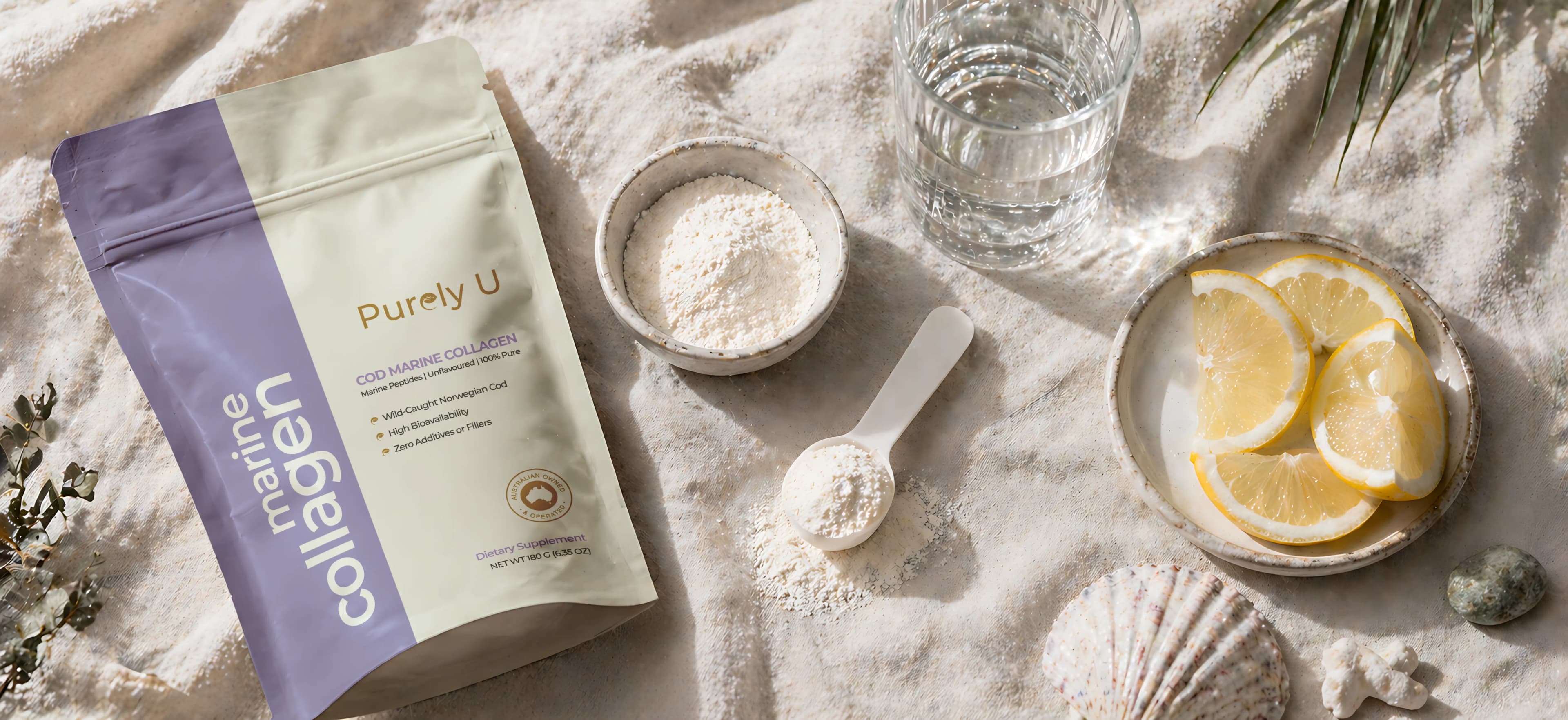
Purely U Cod Marine Collagen is hydrolysed Type I peptides from wild-caught cod, unflavoured, 18 servings per pouch. It is in pre-launch — you can register on the waitlist to be notified when it goes live.
The Honest Bottom Line
Marine collagen peptides are a well-studied supplement with modest but real evidence for skin and joint benefits when used daily for at least 12 weeks. Cod-sourced peptides offer a clean, well-tolerated option with a sustainability story and good taste profile.
Pick a single-ingredient product, use it consistently, and pair it with a vitamin-C-rich diet. Do not expect miracles in week one. Do expect small, measurable changes by week 12 if the rest of the routine is in order.
Tags

Purely U Team
Written by the Purely U wellness team. We are Australian makers of clean-ingredient health and wellness products — HACCP certified, non-GMO, and free from fillers. Our content is reviewed for accuracy and grounded in published nutritional research.
Learn more about us