
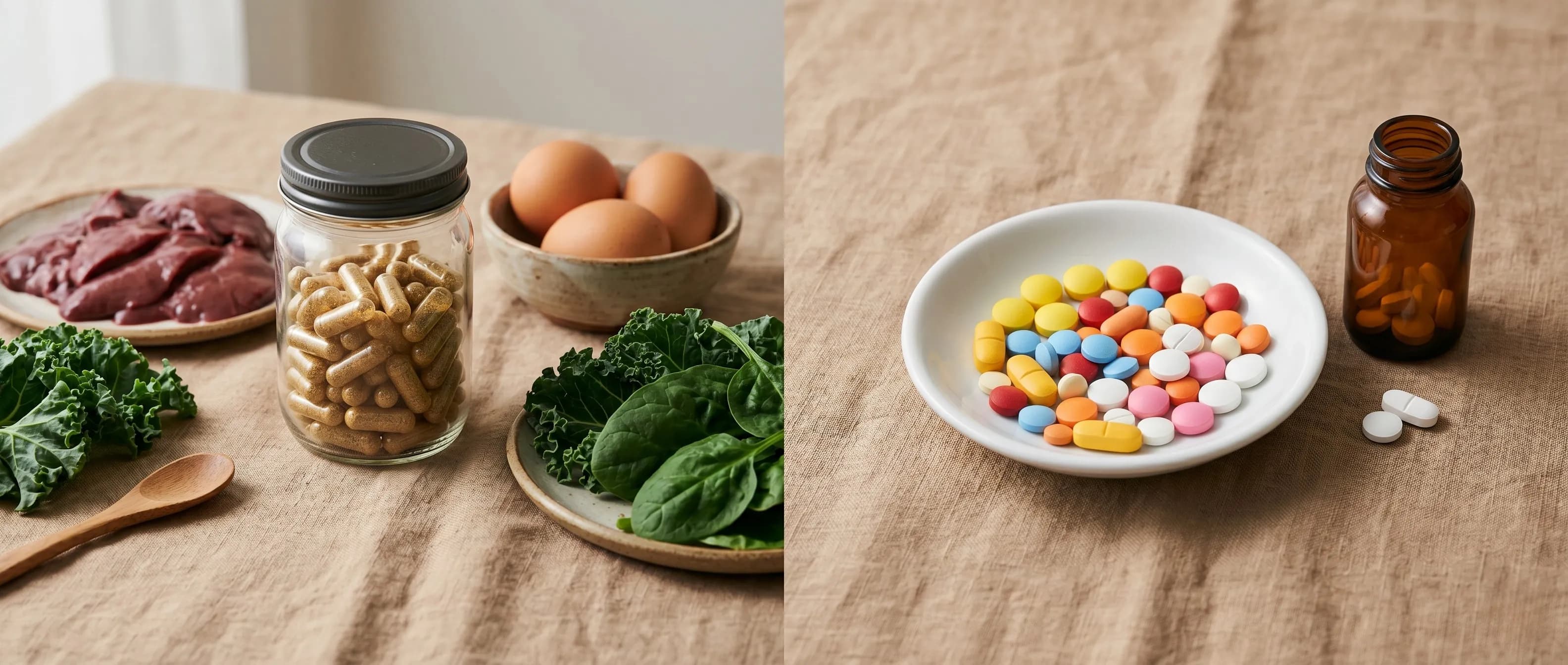
Multivitamins occupy a strange place in the wellness conversation. They are sold as the safety net for a busy modern diet, yet large meta-analyses have repeatedly struggled to show meaningful health benefits in well-fed populations. Beef liver capsules sit on the opposite end of the spectrum — narrow in scope, but concentrated and whole-food sourced.
The right comparison is not which one is better. It is what each one is actually designed to do, and where each one falls short.
The Problem with Most Multivitamins
A standard daily multivitamin contains small, isolated amounts of 20 to 30 vitamins and minerals. Each ingredient is included at a dose calibrated for general dietary insurance — enough to top up a small shortfall, rarely enough to correct an actual deficiency.
Most multivitamins use synthetic forms of each nutrient. Synthetic vitamins are not inherently bad — they are well-studied and widely used — but they arrive in your body without the cofactors that food provides. Vitamin A as retinyl palmitate behaves differently to the vitamin A complex you get from liver. Iron as ferrous sulfate behaves differently to the haem iron in red meat.
There is also a quality variation problem. Two bottles of multivitamins on the same Australian shelf can use very different forms of the same nutrient — folic acid versus methylfolate, for example, or cyanocobalamin versus methylcobalamin for B12. The label looks the same; the absorption is not.
What Beef Liver Actually Contains
Beef liver is one of the most nutrient-dense foods on the planet. A single serve of freeze-dried beef liver capsules naturally delivers:
- Vitamin A as retinol — the active form, in concentrations that easily exceed most multivitamins
- Vitamin B12 in its food-bound form, alongside the cofactors that support B12 metabolism
- Folate as natural folate, not synthetic folic acid
- Haem iron, the form most readily absorbed by the body
- CoQ10, an antioxidant cofactor central to cellular energy production
- Smaller amounts of zinc, copper and choline
Crucially, all of these arrive in their natural ratio and packaged with the proteins and fats that liver contains. That packaging matters because nutrient absorption is rarely about the nutrient alone. The body evolved alongside whole foods, not isolated compounds.
What Beef Liver Cannot Replace
Beef liver is not a complete multivitamin substitute. It contains essentially no vitamin C, no vitamin D, no calcium, and no magnesium in meaningful amounts. Each of those is critical and must come from elsewhere in the diet.
Vitamin C comes from fresh fruit and vegetables. Vitamin D comes from sunlight on bare skin and oily fish — Australians who spend most of the day indoors should consider blood testing in winter. Calcium comes from dairy, leafy greens, sardines, or fortified plant milks. Magnesium comes from nuts, seeds, dark leafy greens, and wholegrains.
If a person treats beef liver capsules as a complete multivitamin replacement and continues to eat a poor diet, they will end up with the same gaps a multivitamin would have left. The product is a concentrated whole-food top-up, not a replacement for a varied diet.
The Case for Combining Both
For most people, the practical answer is neither pure beef liver nor pure multivitamin. It is a focus on whole-food nutrition first, with targeted supplementation where blood work or diet review reveals an actual gap.
Someone with low iron, low B12, and a generally clean diet might choose beef liver capsules over a multivitamin because the active nutrients match the actual gap. Someone on a tightly restricted diet — vegan, long-term low-calorie, post-bariatric — may benefit more from a targeted multivitamin or specific nutrient supplements designed for their situation.
Athletes, people with heavy menstrual bleeding, and pregnant women all have specific nutritional considerations that benefit from a discussion with a clinician rather than a one-size-fits-all bottle. Iron, in particular, should never be supplemented at high doses without testing, because excess iron can be harmful.
How to Decide What You Actually Need
The single most useful step you can take is to get a baseline blood test. A standard panel covering full blood count, ferritin (iron stores), vitamin D, vitamin B12, and folate will reveal more than any amount of label reading. From there, supplementation becomes specific rather than speculative.
For everyday support without diagnosed deficiencies, the priority order is: improve diet, address sleep and sun exposure, and only then consider supplements. When supplements do make sense, choose forms that match what you are trying to achieve. Whole-food liver capsules suit people topping up vitamin A, B12, folate, and iron from a recognisable food source.
For more on individual mineral gaps, see our piece on zinc deficiency in Australia. If you would like to know when our beef liver formula goes live, register on the waitlist.
The Honest Bottom Line
Multivitamins are broad insurance — useful for some, unnecessary for many, and often poorly matched to actual nutrient gaps. Beef liver is narrow but deep — a concentrated whole-food source of specific nutrients that are commonly low in modern Australian diets.
Pick the tool that matches the problem. For most people, that means food first, blood work second, and supplements only where they fill an identified gap.
Tags

Purely U Team
Written by the Purely U wellness team. We are Australian makers of clean-ingredient health and wellness products — HACCP certified, non-GMO, and free from fillers. Our content is reviewed for accuracy and grounded in published nutritional research.
Learn more about us